Metal3DPMETAL3DP
SOFT MAGNETIC & MAGNETIC MATERIAL POWDERSTECHNICAL PRODUCT DATA

FeSiAl Sendust Powder for Power Inductors

Gas-atomized sendust (Fe-9.6Si-5.4Al) powder for 26-125µ power cores. 1.05T saturation, low loss to 200 kHz, certified lot core-loss data. EV charger and solar inductor grades.

Saturation flux density
1.0-1.05 T
Permeability (pressed core)
26, 60, 75, 90, 125 µ standard grades
Core loss
Low — suited to 20-200 kHz power conversion
Particle size
-200 mesh and finer, distribution per permeability grade
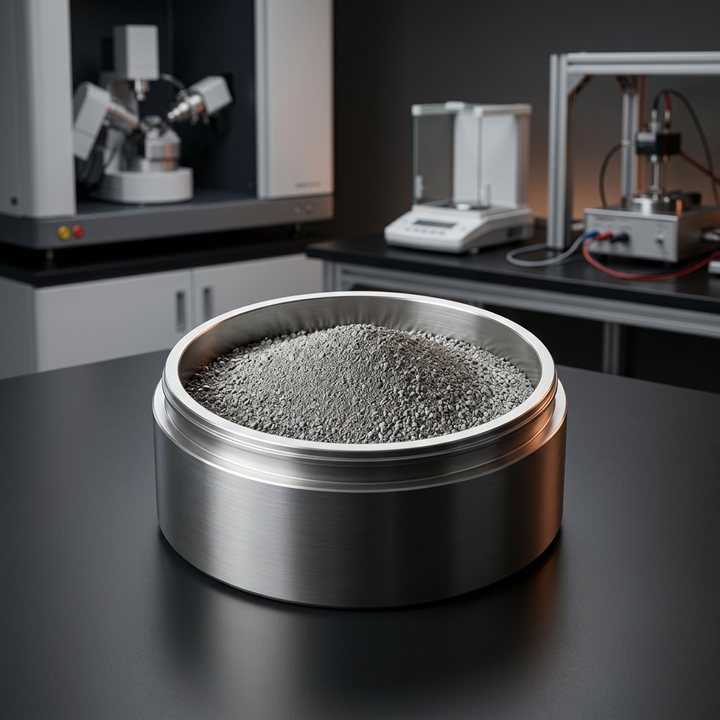
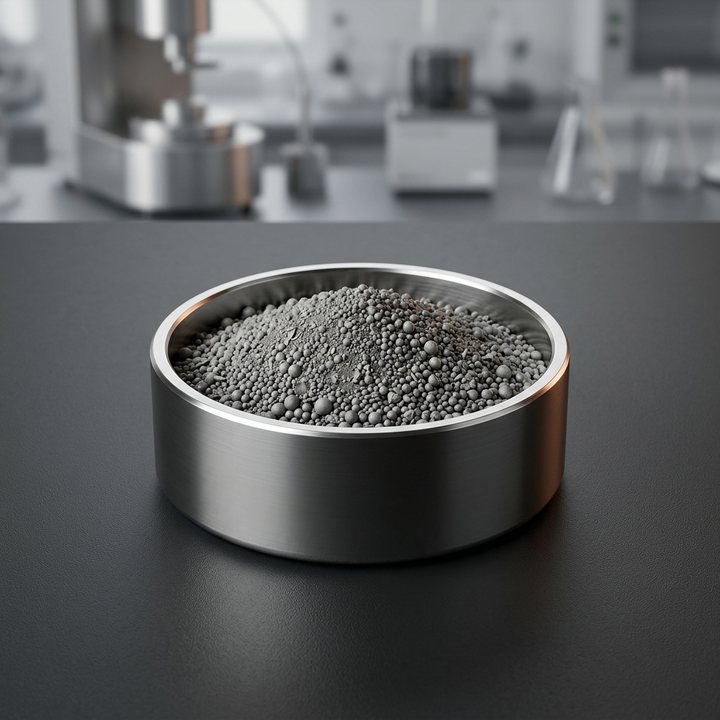
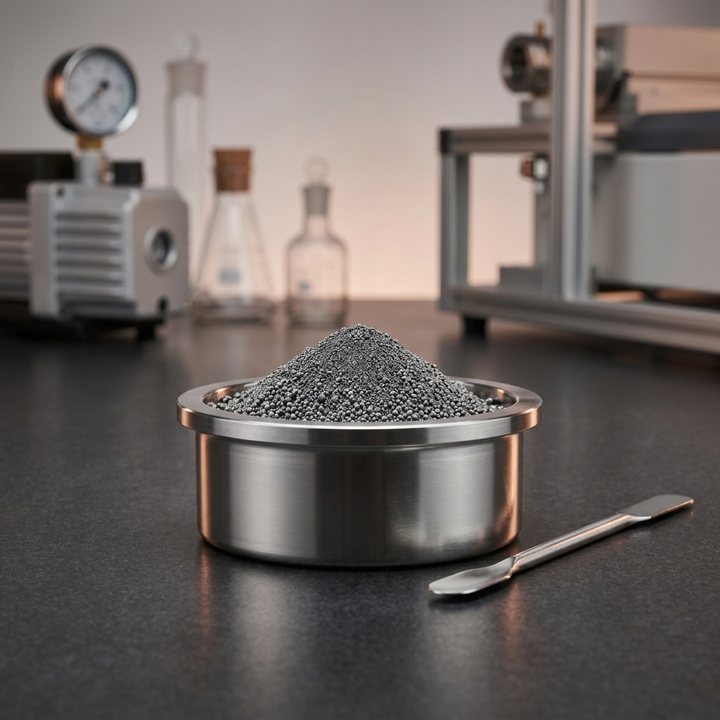
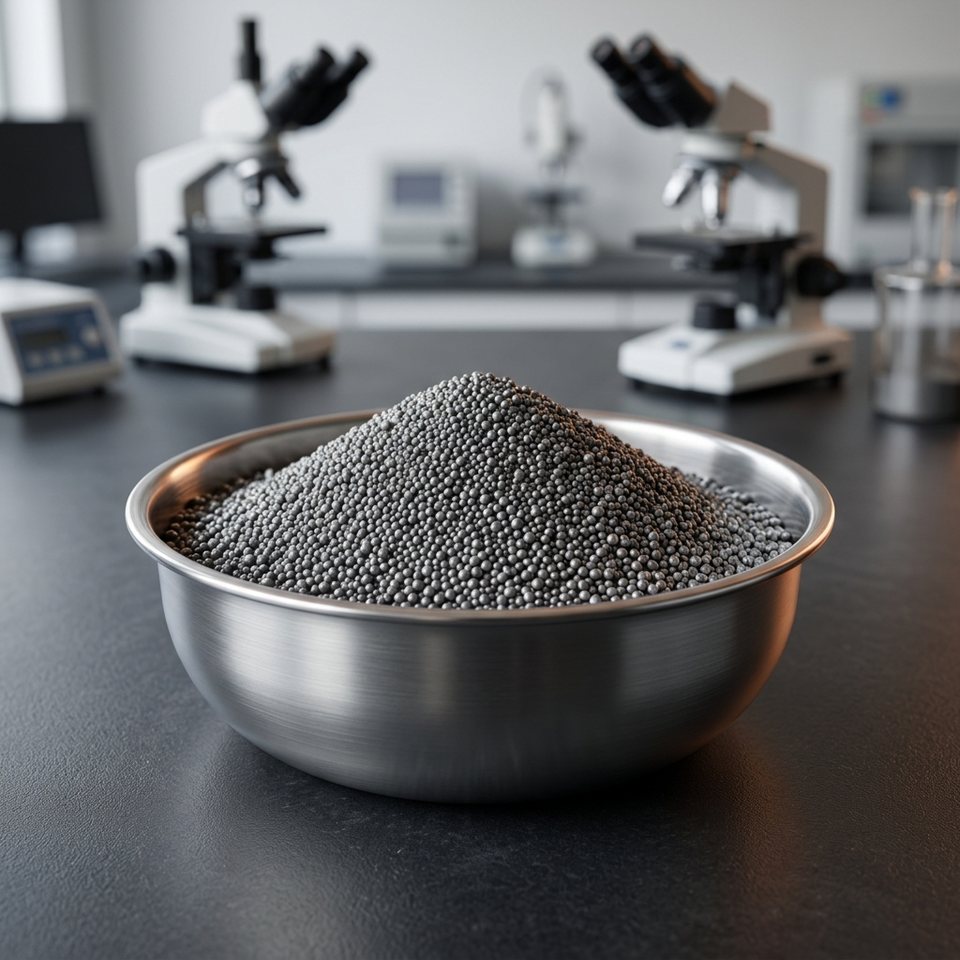
FeSiAl Sendust Powder for Power Inductors metal powder product sample

QUICK ANSWER

Performance Defined by Material and Process.

FeSiAl sendust powder is an iron-silicon-aluminum soft magnetic alloy (typically 85% Fe, 9.6% Si, 5.4% Al) gas-atomized into spherical powder and pressed with insulation coating into toroidal and shaped cores. It delivers high saturation flux density (1.0-1.05 T) with near-zero magnetostriction and low core loss, making it the standard material for power factor correction chokes, output inductors, and EV onboard charger magnetics.

Sendust's composition sits at a metallurgical sweet spot where both magnetostriction and magnetocrystalline anisotropy approach zero simultaneously — the origin of its soft magnetic excellence. Compared with pure iron powder cores it cuts core loss dramatically at frequencies above 20 kHz; compared with ferrite it carries three times the flux density, shrinking inductor size. Gas atomization gives the spherical, smooth-surface particles that insulate uniformly and press to high density — powder morphology directly determines core loss in the finished component.

MATERIAL DATA

Chemistry and Technical Performance.

Lot-level controls focus on the chemistry, particle characteristics, and process values that influence manufacturing consistency and finished-part performance.

Chemical Composition

TYPICAL
ElementContentPerformance Role
Iron (Fe)Balance (~85 wt%)Magnetic base providing high saturation flux density
Silicon (Si)9.6 wt%Raises resistivity, cuts eddy loss; at 9.6% drives anisotropy toward zero
Aluminum (Al)5.4 wt%At 5.4% drives magnetostriction toward zero — the sendust sweet spot
Oxygen (O)< 500 ppmLow oxygen preserves permeability and reduces loss
Carbon + others< 0.05 wt%Impurity control for magnetic softness

Technical Specifications

BASE GRADE
Saturation flux density
1.0-1.05 T
Permeability (pressed core)
26, 60, 75, 90, 125 µ standard grades
Core loss
Low — suited to 20-200 kHz power conversion
Particle size
-200 mesh and finer, distribution per permeability grade
Curie temperature
~500 °C
Forms
Atomized spherical powder for insulated pressing

Final limits can be aligned with the agreed purchase specification.

APPLICATIONS

Developed for Demanding Industrial Applications.

01

Power conversion magnetics are the defining market

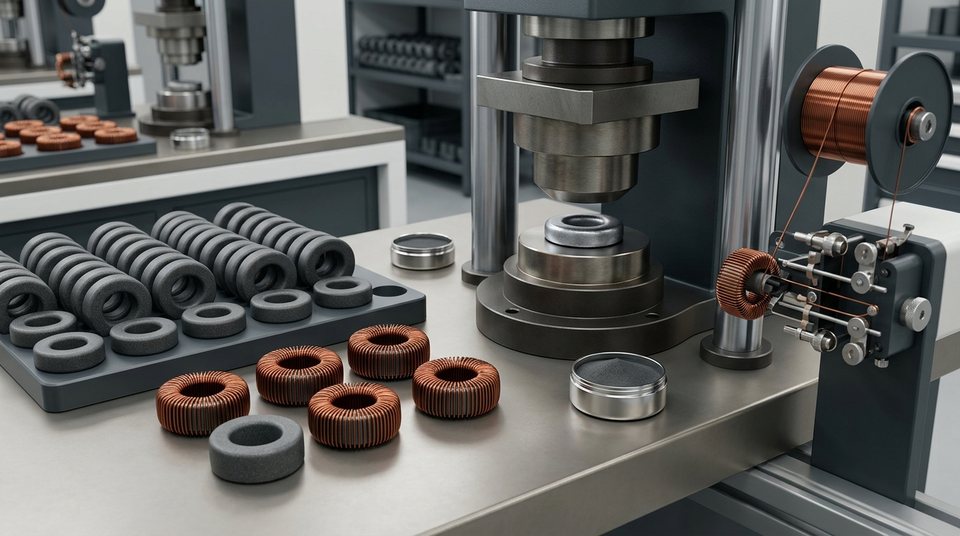
Power conversion magnetics are the defining market: PFC chokes in server power supplies, output inductors in solar inverters, filter chokes in EV onboard chargers, and DC-DC inductors across industrial electronics are pressed from sendust cores. The distributed air gap formed by the insulated particles gives a soft, saturating characteristic ideal for chokes carrying DC bias — where ferrite would saturate abruptly. Core manufacturers buy the powder on loss performance at specified frequency and flux, particle size distribution consistency, and insulation compatibility.

02

The EV and renewable energy buildout is driving demand sharply upward

The EV and renewable energy buildout is driving demand sharply upward: every onboard charger, DC fast-charging station, and string inverter consumes sendust or similar alloy cores, and the shift to higher switching frequencies favors powder cores over laminations. Emerging uses include molded inductors for automotive electronics and integrated magnetics for GaN/SiC converters, where sendust's frequency capability meets the new wide-bandgap switching speeds.

FeSiAl Sendust Powder for Power Inductors industrial application detail

SOFT MAGNETIC & MAGNETIC MATERIAL POWDERS

CUSTOM SUPPLY

A Supply Specification Built Around Your Process.

We supply gas-atomized sendust powder in standard permeability-grade size distributions with certified low loss and oxygen content, plus FeSi, FeNi, and amorphous alternatives for comparison. Custom size cuts for molded inductor compaction, phosphated or inorganic-coated insulation-ready grades, and core-loss data per lot (at 50 kHz/100 mT or your test condition) are standard. Not export-controlled.

01

We supply gas-atomized sendust powder in standard permeability-grade size distributions with certified low loss and oxygen content, plus FeSi, FeNi, and amorphous alternatives for comparison.

02

Custom size cuts for molded inductor compaction, phosphated or inorganic-coated insulation-ready grades, and core-loss data per lot (at 50 kHz/100 mT or your test condition) are standard.

MATERIAL COMPARISON

Compare Materials Against the Production Requirement.

Sendust vs Pure Iron Powder Cores

Comparison PointThis ProductIron Powder
Core loss at 50 kHzLow3-5x higher
Saturation flux density1.0-1.05 T1.3-1.5 T — higher
CostModerateLowest
DC bias capabilityGoodGood
Frequency rangeTo 200+ kHzBelow ~20 kHz economical
Best usePFC, mid-frequency chokesLow-frequency, cost-driven chokes

TECHNICAL FAQ

Technical Questions About This Grade.

Need a different chemistry, particle range, or processing route? Our material team can review the requirement and supply window.

Which permeability grade should I choose?

Lower permeability (26-60 µ) gives better DC bias and lower loss for high-current chokes; higher permeability (90-125 µ) suits lower-current filter applications. The permeability comes from particle size and insulation thickness — we supply powder matched to your target grade.

Can sendust cores work at 100 °C+ ambient?

Yes — the Curie point near 500 °C gives wide margin, and core loss actually decreases slightly with temperature. Insulation binder rating, not the alloy, sets the practical limit.

How does powder morphology affect finished core loss?

Smooth spherical particles insulate uniformly with thin coating, raising density and lowering hysteresis loss; irregular particles need thicker insulation and trap more air gap, raising loss. Our gas-atomized powder is specified on sphericity for exactly this reason.

Do you supply insulation-coated powder?

We supply insulation-ready powder with surface condition matched to phosphating or inorganic coating processes; fully coated powder on request for customers without in-house coating lines.

Is sendust export-controlled?

No. Iron-silicon-aluminum soft magnetic powder ships without licensing requirements.

REQUEST THIS GRADE

Turn Your Production Requirement Into a Powder Specification.

Share your target chemistry, particle size, process, annual volume, and destination. Our powder specialists will confirm the closest production grade and documentation package.

Talk to a Powder Specialist
Send Inquiry