Metal3DPMETAL3DP
SOFT MAGNETIC & MAGNETIC MATERIAL POWDERSTECHNICAL PRODUCT DATA

FeSiB Amorphous & Nanocrystalline Powder

Amorphous and nanocrystalline (FeSiBPCu) powder for 5-500 kHz inductors, wireless charging and EMI cores. XRD-certified amorphous fraction, lot loss data, no rare earths.

Core loss
Fraction of crystalline Fe at 10-100 kHz
Saturation flux density
1.2-1.6 T (grade dependent)
Structure
Amorphous or ~15 nm nanocrystalline in amorphous matrix
Forms
Gas-atomized spherical, milled ribbon flake
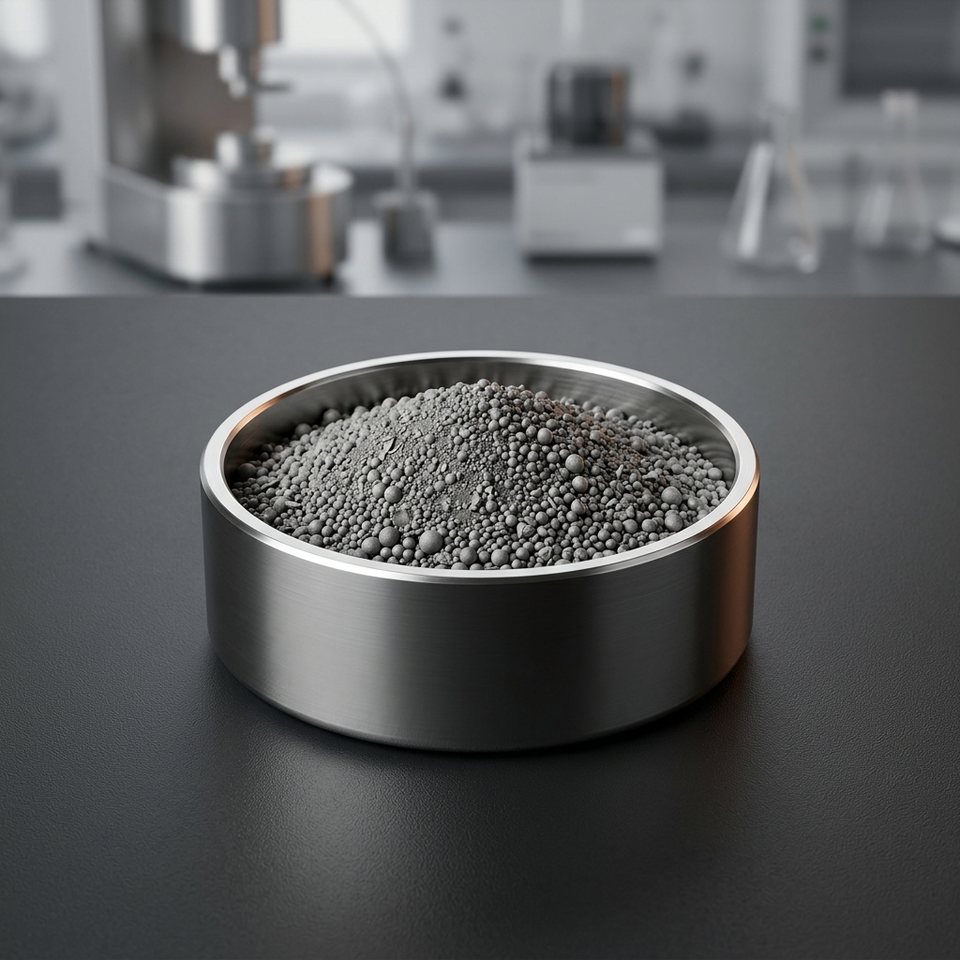
FeSiB Amorphous & Nanocrystalline Powder metal powder product sample

QUICK ANSWER

Performance Defined by Material and Process.

FeSiB-based amorphous and nanocrystalline powders are iron-boron-silicon alloys (with Cu/Nb additions in nanocrystalline grades, e.g. FeSiBPCu) rapidly solidified into powder whose atomic structure is glassy or nano-grained — delivering core losses a fraction of crystalline iron powder at 10-100 kHz. They serve high-frequency inductors, wireless power transfer, and EMI suppression where conventional powder cores generate too much heat.

Amorphous metals freeze without crystal structure, eliminating magnetocrystalline anisotropy and slashing hysteresis loss; nanocrystalline alloys add a controlled crystallization of ~15 nm grains in an amorphous matrix for near-zero magnetostriction with high permeability. In ribbon form these materials transformed distribution transformers; in powder form — made by gas atomization with extreme cooling or by milling ribbon — they bring the same loss advantage to pressed and molded geometries. The technical challenge is fragility and stress sensitivity: powder pressing and insulation must avoid degrading the glassy structure, which is why powder morphology and process know-how carry the value.

MATERIAL DATA

Chemistry and Technical Performance.

Lot-level controls focus on the chemistry, particle characteristics, and process values that influence manufacturing consistency and finished-part performance.

Chemical Composition

TYPICAL
ElementContentPerformance Role
Iron (Fe)Balance (~75-85 wt%)Ferromagnetic base
Silicon (Si)5-10 wt%Glass former and resistivity raiser
Boron (B)2-8 wt%Primary glass-forming element enabling amorphization
Phosphorus/Copper/Niobium0-5 wt% (nanocrystalline grades)Cu triggers nanocrystallization; Nb/P refine grain size
Oxygen (O)< 1000 ppmOxide disrupts glass formation and raises loss

Technical Specifications

BASE GRADE
Core loss
Fraction of crystalline Fe at 10-100 kHz
Saturation flux density
1.2-1.6 T (grade dependent)
Structure
Amorphous or ~15 nm nanocrystalline in amorphous matrix
Forms
Gas-atomized spherical, milled ribbon flake
Frequency range
5 kHz-500 kHz application dependent
Caution
Stress-sensitive — pressing degrades properties if mishandled

Final limits can be aligned with the agreed purchase specification.

APPLICATIONS

Developed for Demanding Industrial Applications.

01

High-frequency power magnetics are the core market

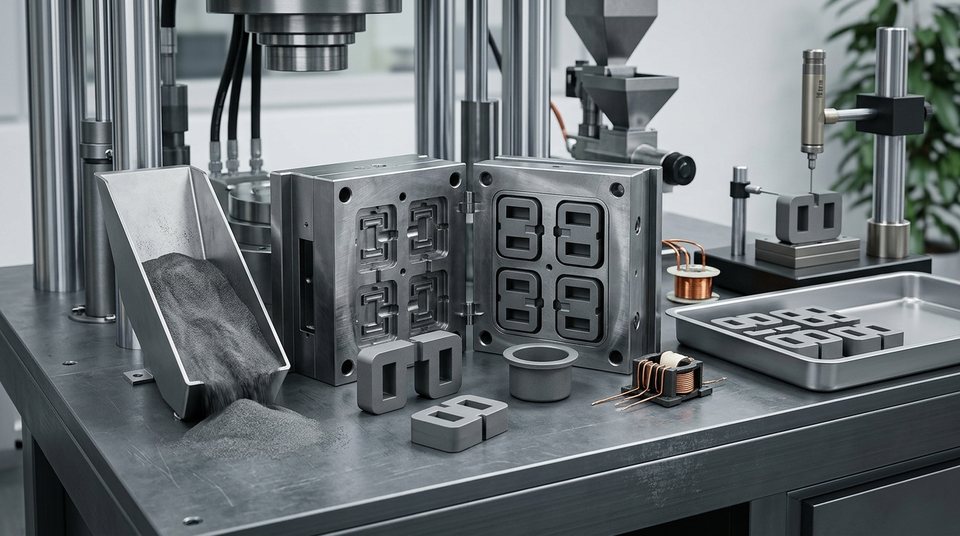
High-frequency power magnetics are the core market: inductors and transformers in server power supplies running wide-bandgap switches, wireless charging coils for EVs and consumer devices, and high-frequency PFC stages all chase the loss advantage of amorphous/nanocrystalline materials. Powder cores and molded parts extend this advantage into geometries that ribbon wound cores cannot fill — gapped E-cores, pot cores, toroids with distributed gap, and integrated molded magnetics. Buyers are magnetics manufacturers with ribbon experience branching into powder parts, and they buy on certified loss data at their exact test conditions.

02

EMI suppression is the second market

EMI suppression is the second market: amorphous and nanocrystalline powder pressed or loaded into composites makes common-mode choke cores and absorption sheets with extreme permeability at noise frequencies. Data center, automotive, and industrial drive applications all need ever-smaller EMI filters, and the permeability of nanocrystalline material at 100 kHz-1 MHz is unmatched by ferrite — enabling smaller cores that fit shrinking power electronics enclosures.

FeSiB Amorphous & Nanocrystalline Powder industrial application detail

SOFT MAGNETIC & MAGNETIC MATERIAL POWDERS

CUSTOM SUPPLY

A Supply Specification Built Around Your Process.

We supply FeSiB-based amorphous atomized powder, nanocrystalline (FeSiBPCu-type) powder, and milled ribbon flake with certified amorphous fraction (XRD data) and core loss at standard points. Custom compositions for specific permeability-loss targets, flake aspect ratios for absorption composites, and process guidance for low-degradation pressing are available. Not export-controlled (iron-based; contains no controlled rare earths).

01

We supply FeSiB-based amorphous atomized powder, nanocrystalline (FeSiBPCu-type) powder, and milled ribbon flake with certified amorphous fraction (XRD data) and core loss at standard points.

02

Custom compositions for specific permeability-loss targets, flake aspect ratios for absorption composites, and process guidance for low-degradation pressing are available.

MATERIAL COMPARISON

Compare Materials Against the Production Requirement.

Amorphous/Nanocrystalline vs Sendust Powder Cores

Comparison PointThis ProductSendust
Core loss at 50 kHzDramatically lowerModerate
Saturation flux density1.2-1.6 T~1.05 T
Pressing toleranceSensitive — stress degrades µRobust
CostHighModerate
Permeability (nanocrystalline)Very high available26-125 µ
Best useLoss-critical, high-frequency magneticsVolume power chokes, cost-sensitive

TECHNICAL FAQ

Technical Questions About This Grade.

Need a different chemistry, particle range, or processing route? Our material team can review the requirement and supply window.

How much does pressing degrade amorphous powder cores?

Significantly if done wrong — high pressure induces stress that raises hysteresis loss. Low-pressure compaction with compliant binders and stress-relief annealing below crystallization temperature preserves most of the advantage. We provide process windows with each grade.

Amorphous or nanocrystalline — which do I need?

Amorphous for lowest loss at high flux swing (inductors); nanocrystalline for maximum permeability (EMI, common-mode chokes, sensing). If your spec is attenuation per volume, nanocrystalline usually wins.

What does amorphous fraction mean and why certify it?

Any crystalline content in the powder raises loss and permeability variance. We certify amorphous fraction by XRD per lot — >95% amorphous is our standard atomized grade.

Can the powder be used in injection-molded composite cores?

Yes — polymer-bonded amorphous powder composites serve low-pressure molding for complex EMI and sensor parts, trading some permeability for total geometry freedom.

Is this material affected by rare-earth export controls?

No — these are iron-metalloid alloys containing no rare earths. They ship without licensing requirements.

REQUEST THIS GRADE

Turn Your Production Requirement Into a Powder Specification.

Share your target chemistry, particle size, process, annual volume, and destination. Our powder specialists will confirm the closest production grade and documentation package.

Talk to a Powder Specialist
Send Inquiry