Metal3DPMETAL3DP
LASER CLADDING & DIRECTED ENERGY REPAIR POWDERSTECHNICAL PRODUCT DATA

Ni60 Nickel-Based Laser Cladding Powder

Spherical gas-atomized Ni60 for laser cladding — metallurgical bond, < 5% dilution, chrome-plating replacement. WC-reinforced blends available. Lot-certified flow and chemistry.

Deposit hardness
58-62 HRC
Particle size
45-106 µm (coaxial), 20-53 µm (high-speed cladding)
Morphology
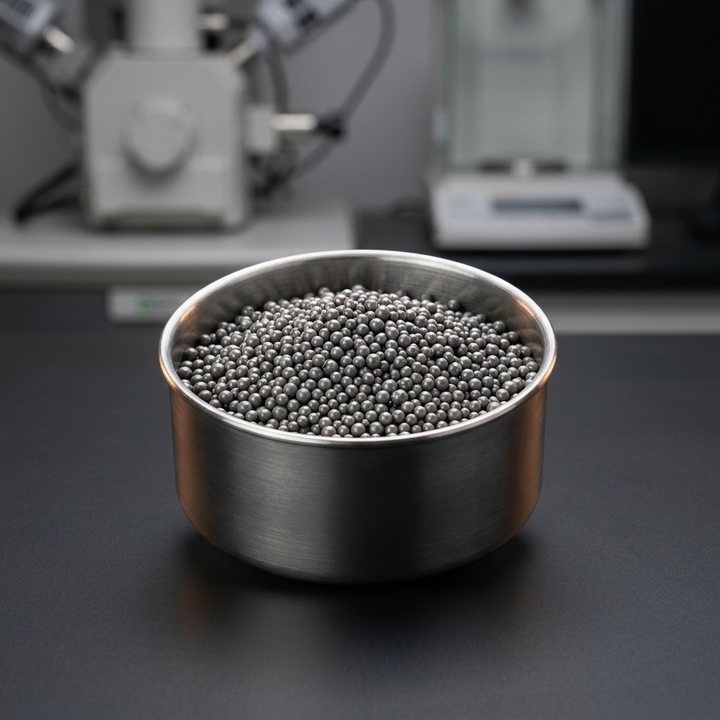
Spherical, gas atomized
Dilution
< 5% with optimized parameters
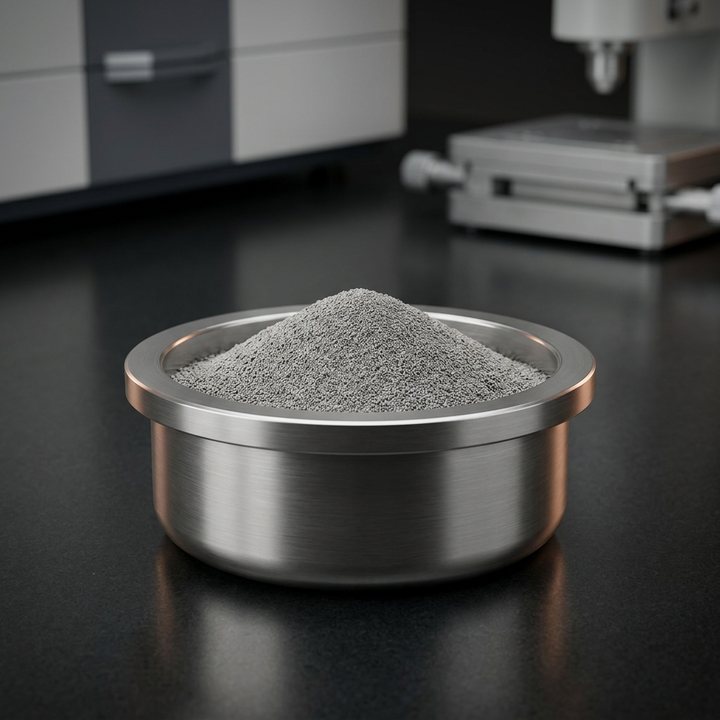
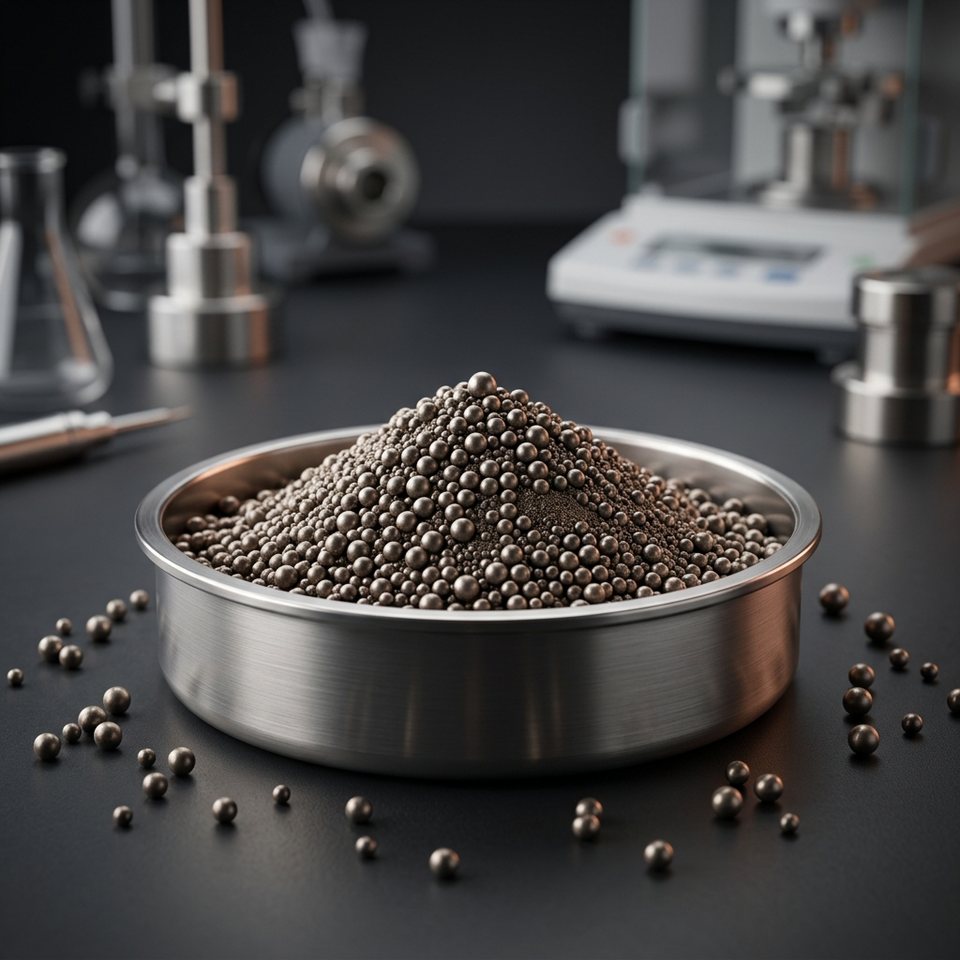
Ni60 Nickel-Based Laser Cladding Powder metal powder product sample

QUICK ANSWER

Performance Defined by Material and Process.

Ni60 laser cladding powder is a nickel-chromium-boron-silicon self-fluxing alloy optimized for laser deposition, producing 58-62 HRC wear-resistant layers with strong metallurgical bonding and dilution below 5 percent. It is the most widely used laser cladding powder in China and globally for hardfacing shafts, hydraulic rods, valve components, and mining equipment — the laser-process counterpart of the classic spray-fuse NiCrBSi family.

The laser cladding version of Ni60 differs from the spray grade in particle engineering: spherical gas-atomized morphology for reliable pneumatic feeding through fine cladding nozzles, a tighter size cut, and chemistry adjusted for rapid laser melting rather than torch fusing. The deposited layer keeps the family's signature combination — chromium borides and carbides in a tough nickel matrix — but with the low dilution, low distortion, and near-net geometry that only laser processing delivers, often eliminating the need for post-weld stress relief.

MATERIAL DATA

Chemistry and Technical Performance.

Lot-level controls focus on the chemistry, particle characteristics, and process values that influence manufacturing consistency and finished-part performance.

Chemical Composition

TYPICAL
ElementContentPerformance Role
Nickel (Ni)Balance (> 65 wt%)Tough, corrosion-resistant matrix carrying the hard phases
Chromium (Cr)14-17 wt%Forms CrB and Cr7C3 hard phases; boosts oxidation resistance
Boron (B)3.0-4.5 wt%Self-fluxing agent and boride former — the main hardness contributor
Silicon (Si)3.5-5.0 wt%Melting-point depressant ensuring smooth laser melting and wetting
Iron (Fe)< 10 wt%Cost-balancing addition with minor hardness penalty

Technical Specifications

BASE GRADE
Deposit hardness
58-62 HRC
Particle size
45-106 µm (coaxial), 20-53 µm (high-speed cladding)
Morphology
Spherical, gas atomized
Dilution
< 5% with optimized parameters
Layer thickness per pass
0.3-1.5 mm
Bond type
Full metallurgical

Final limits can be aligned with the agreed purchase specification.

APPLICATIONS

Developed for Demanding Industrial Applications.

01

Hydraulic equipment is the largest single market

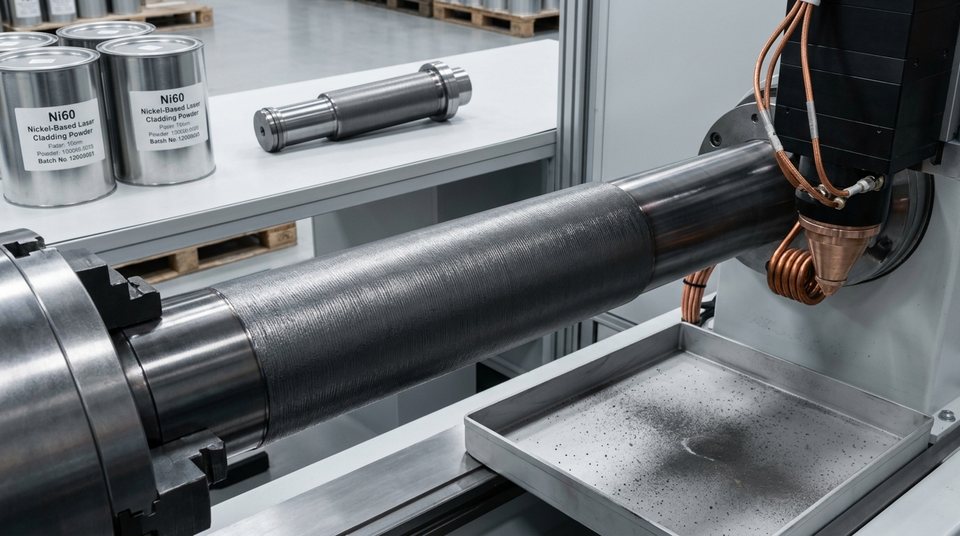
Hydraulic equipment is the largest single market: excavator and press hydraulic rods clad with Ni60 replace hard chrome with a layer that bonds metallurgically, resists impact spalling, and survives the side-loading that cracks chrome. Chinese and European remanufacturers now specify laser-clad Ni60 as the default rod overhaul route, buying powder in pallet quantities on flow consistency and crack-free deposit guarantees. The same logic applies to pump shafts, plunger pistons, and seal journals across process industries.

02

Mining and heavy machinery form the second pillar

Mining and heavy machinery form the second pillar: coal mine hydraulic prop cylinders, roadheader picks holders, crusher components, and conveyor drive shafts are clad with Ni60 or WC-reinforced Ni60 to survive abrasive overburden service. Here the laser process's low heat input matters as much as the alloy — thin-walled cylinders and heat-treated shaft substrates cannot tolerate torch fusing temperatures, and laser cladding deposits the wear layer without destroying the component's core properties.

Ni60 Nickel-Based Laser Cladding Powder industrial application detail

LASER CLADDING & DIRECTED ENERGY REPAIR POWDERS

CUSTOM SUPPLY

A Supply Specification Built Around Your Process.

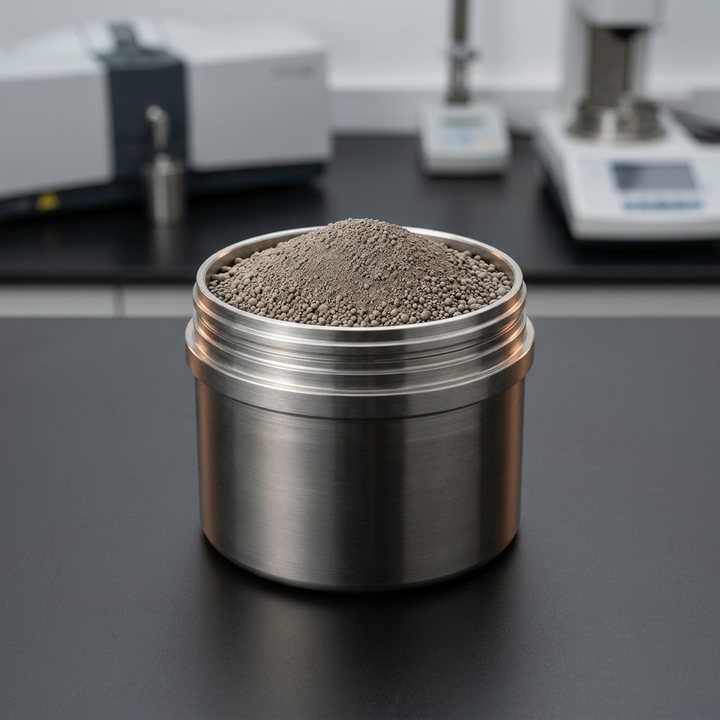
We supply Ni60 in spherical gas-atomized form, standard 45-106 µm and high-speed-cladding 20-53 µm cuts, with Hall flow and chemistry certification per lot. WC-reinforced blends (Ni60 + 25-35% WC) for extreme abrasion, lower-hardness Ni45/Ni55 laser grades for machinable deposits, and custom boron levels for crack sensitivity control on difficult substrates are available. Not export-controlled.

01

We supply Ni60 in spherical gas-atomized form, standard 45-106 µm and high-speed-cladding 20-53 µm cuts, with Hall flow and chemistry certification per lot.

02

WC-reinforced blends (Ni60 + 25-35% WC) for extreme abrasion, lower-hardness Ni45/Ni55 laser grades for machinable deposits, and custom boron levels for crack sensitivity control on difficult substrates are available.

MATERIAL COMPARISON

Compare Materials Against the Production Requirement.

Ni60 Laser Cladding vs Hard Chrome Plating

Comparison PointThis ProductHard Chrome Plating
Bond typeMetallurgical — will not spallAdhesive — spalls under impact and bending
Hardness58-62 HRC, plus hard boride phases66-70 HRC but no hard-phase reinforcement
Thickness capability0.3-3 mm — rebuilds worn parts20-100 µm — dimension-limited
Environmental complianceClean processHexavalent chromium — restricted under REACH
Side-load / impact serviceExcellentPoor — microcracking
Cost per overhaulCompetitive at damage rebuildCheap for new-part protection only

TECHNICAL FAQ

Technical Questions About This Grade.

Need a different chemistry, particle range, or processing route? Our material team can review the requirement and supply window.

When should I preheat before cladding Ni60?

On large parts, high-carbon or cast iron substrates, and whenever ambient temperature is low, 200-350 °C preheat reduces thermal stress and prevents cracking. Ni45 or Fe-based grades are the alternative when preheat is impractical.

Can Ni60 be clad on cast iron?

Yes with care — preheat and a ductile Ni45 buffer layer are recommended because cast iron's carbon migrates into the deposit. Many shops standardize on a two-layer Ni45 + Ni60 system for cast iron.

What laser power do I need?

Ni60 runs well on standard 2-6 kW fiber lasers at 0.8-2.0 kW/mm² power density with argon shielding. High-speed cladding systems use the finer 20-53 µm cut at higher traverse speeds for thinner, smoother layers.

How does laser-clad Ni60 differ from spray-fused NiCrBSi?

Same alloy family, different process physics: laser cladding gives lower dilution, minimal distortion, no need to heat the whole part, and better precision — but spray-fuse remains cheaper for large simple surfaces. Many shops run both.

Is Ni60 laser powder export-controlled?

No. Nickel-based cladding powders ship without licensing requirements.

REQUEST THIS GRADE

Turn Your Production Requirement Into a Powder Specification.

Share your target chemistry, particle size, process, annual volume, and destination. Our powder specialists will confirm the closest production grade and documentation package.

Talk to a Powder Specialist
Send Inquiry