Metal3DPMETAL3DP
SOFT MAGNETIC & MAGNETIC MATERIAL POWDERSTECHNICAL PRODUCT DATA

Strontium Ferrite Powder for Bonded & Sintered Magnets

SrFe12O19 powder for sintered anisotropic and bonded magnets. Br to 440 mT, 250°C stability, no rare earths, no export controls. Press-ready granulate and La-Co high-performance grades.

Remanence (Br)
200-230 mT (isotropic), 380-440 mT (anisotropic)
Coercivity (Hcj)
250-400 kA/m grade dependent
Max service temperature
250 °C — far above NdFeB
Particle size
0.8-1.2 µm (sintering grade), 1-3 µm (bonded grade)
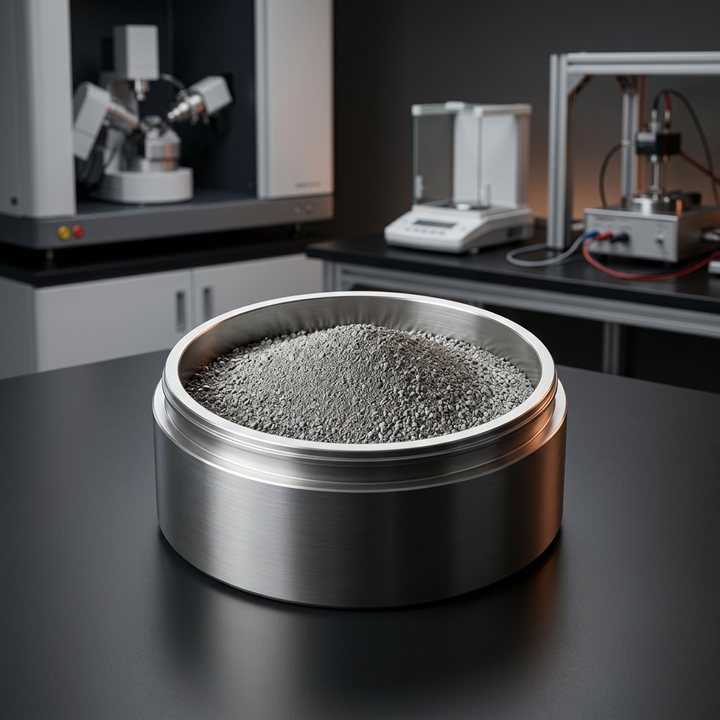
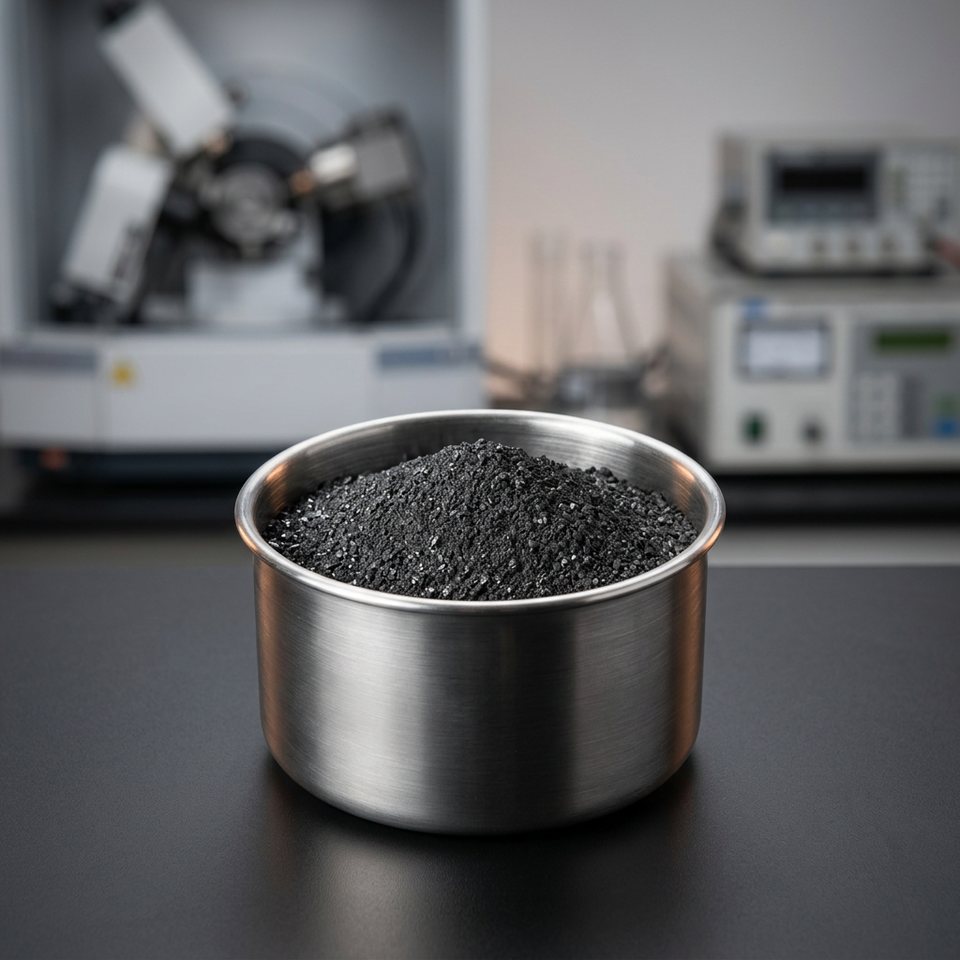
Strontium Ferrite Powder for Bonded & Sintered Magnets metal powder product sample

QUICK ANSWER

Performance Defined by Material and Process.

Strontium ferrite powder (SrFe₁₂O₁₉, SrO·6Fe₂O₃) is a hard magnetic ceramic powder pressed and sintered — or bonded in polymer — into permanent magnets: the ferrite magnets in loudspeakers, DC motors, magnetic separators, and refrigerator seals. It is the highest-volume permanent magnet material on earth, offering reliable magnetism at a cost per unit of energy far below rare-earth magnets — with no rare-earth content and no export-control exposure.

Strontium ferrite's hexagonal magnetoplumbite crystal structure gives strong magnetocrystalline anisotropy: aligned during pressing in a magnetic field, the powder sinters into anisotropic magnets with Br of 380-440 mT and excellent coercivity, stable to 250 °C and corrosion-proof without coating. The powder itself is the product — ferrite magnet producers buy calcined, milled powder with controlled particle size (0.8-1.2 µm for anisotropic sintering) and magnetic properties, since their value-add is the pressing-alignment-sintering process. For bonded magnets, coarser powder loads into nylon or rubber at 60-65% volume for injection-molded and extruded flexible magnets.

MATERIAL DATA

Chemistry and Technical Performance.

Lot-level controls focus on the chemistry, particle characteristics, and process values that influence manufacturing consistency and finished-part performance.

Chemical Composition

TYPICAL
ElementContentPerformance Role
Strontium oxide (SrO)~10-11 wt%Forms the magnetoplumbite structure with iron oxide
Iron oxide (Fe₂O₃)~89-90 wt%Magnetic iron sublattice of the ferrite
Calcium/Silica additions0-1 wt% (sintering aids)Control grain growth and density during sintering
Lanthanum/Cobalt (La-Co grades)0-3 wt% (high-performance)Substitutions raising Br and HcJ in premium grades
Impurities< 1% combinedExcess silica/alumina degrade magnetic properties

Technical Specifications

BASE GRADE
Remanence (Br)
200-230 mT (isotropic), 380-440 mT (anisotropic)
Coercivity (Hcj)
250-400 kA/m grade dependent
Max service temperature
250 °C — far above NdFeB
Particle size
0.8-1.2 µm (sintering grade), 1-3 µm (bonded grade)
Forms
Calcined milled powder, granulated press-ready, bonded compounds
Corrosion
Inherently resistant — no coating needed

Final limits can be aligned with the agreed purchase specification.

APPLICATIONS

Developed for Demanding Industrial Applications.

01

DC motor manufacturing consumes the majority of strontium ferrite

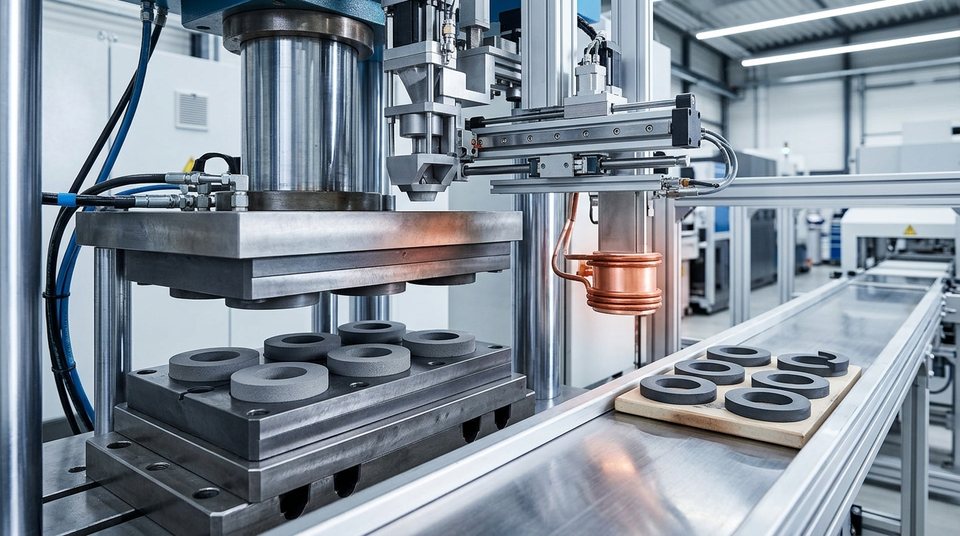
DC motor manufacturing consumes the majority of strontium ferrite: automotive auxiliary motors (window, wiper, fan, seat), appliance motors, power tool motors, and industrial PM DC motors run on ferrite arc and ring magnets by the billions. Motor magnet producers buy press-ready granulated powder and wet-press in oriented field, then sinter — their purchase criteria are magnetic properties per lot (Br, Hcj), particle size consistency affecting pressability, and price stability. The automotive electrification paradox works in ferrite's favor: while traction motors use rare earths, every EV adds dozens of small auxiliary motors that run on ferrite.

02

Bonded and flexible magnets form the second stream

Bonded and flexible magnets form the second stream: injection-molded sensor magnets, rotor position magnets, refrigerator door seals, magnetic sheets, and signage. Here the powder loads into polymer compounds — the buyer is a compounder or molder needing consistent particle size and surface treatment for dispersion. Loudspeakers, magnetic separators, holding systems, and craft magnets round out a market that is mature but vast, and newly attractive as rare-earth price volatility pushes designers back toward ferrite wherever size permits.

Strontium Ferrite Powder for Bonded & Sintered Magnets industrial application detail

SOFT MAGNETIC & MAGNETIC MATERIAL POWDERS

CUSTOM SUPPLY

A Supply Specification Built Around Your Process.

We supply strontium ferrite powder in sintering grade (sub-micron, for anisotropic wet pressing), bonded grade (coarser, surface-treated for polymer dispersion), and high-performance La-Co substituted grades approaching 440 mT. Granulated press-ready powder, custom particle size distributions, and lot magnetic property certification (Br, Hcb, Hcj, BHmax on pressed-sintered samples) are standard. Contains no controlled materials — ships freely, a decisive advantage over rare-earth magnets under current export policy.

01

We supply strontium ferrite powder in sintering grade (sub-micron, for anisotropic wet pressing), bonded grade (coarser, surface-treated for polymer dispersion), and high-performance La-Co substituted grades approaching 440 mT.

02

Granulated press-ready powder, custom particle size distributions, and lot magnetic property certification (Br, Hcb, Hcj, BHmax on pressed-sintered samples) are standard.

03

Contains no controlled materials — ships freely, a decisive advantage over rare-earth magnets under current export policy.

MATERIAL COMPARISON

Compare Materials Against the Production Requirement.

Sr Ferrite vs NdFeB Magnets

Comparison PointThis ProductSintered NdFeB
Energy product (BHmax)30-45 kJ/m³250-450 kJ/m³ — 10x
Cost per magnet energyLowest available5-20x higher, price volatile
Temperature stabilityExcellent to 250 °CDegrades above 80-200 °C grade dependent
CorrosionImmune — ceramicRequires coating
Export control statusNone — ships freelyChinese licensing regime applies
Best useMotors, speakers, cost-driven volumeMiniaturized, performance-critical

TECHNICAL FAQ

Technical Questions About This Grade.

Need a different chemistry, particle range, or processing route? Our material team can review the requirement and supply window.

Can ferrite replace NdFeB in my motor design?

Where package size allows 1.5-2x the magnet volume, often yes — with major wins in cost, temperature stability, and supply security. Flux concentration designs (spoke rotors) have made ferrite traction-adjacent motors viable. We supply samples for your motor R&D.

What is the difference between your powder and press-ready granulate?

Base powder is sub-micron milled calcine; press-ready granulate adds binder and is spray-dried into free-flowing granules for dry pressing. Wet-pressing anisotropic producers take the milled powder slurry form. Specify your process.

What do La-Co substituted grades offer?

Lanthanum-cobalt substitution raises both Br and Hcj, closing part of the gap to bonded NdFeB while keeping ferrite's cost and temperature advantages. Note these grades contain lanthanum — a light rare earth outside China's 2025 control scope — and ship without licensing.

How do I qualify powder lots for sintered magnet production?

We certify Br, Hcb, Hcj, and BHmax on pressed-sintered standard samples per lot, plus particle size distribution and specific surface area. Qualification typically runs three consecutive lots against your process.

Is strontium ferrite export-controlled?

No — it contains no rare earths or controlled materials. This is a structural advantage over rare-earth magnets under current Chinese export licensing regimes.

REQUEST THIS GRADE

Turn Your Production Requirement Into a Powder Specification.

Share your target chemistry, particle size, process, annual volume, and destination. Our powder specialists will confirm the closest production grade and documentation package.

Talk to a Powder Specialist
Send Inquiry